Professor Jack Scarisbrick MBE
1928-2026
Our tribute
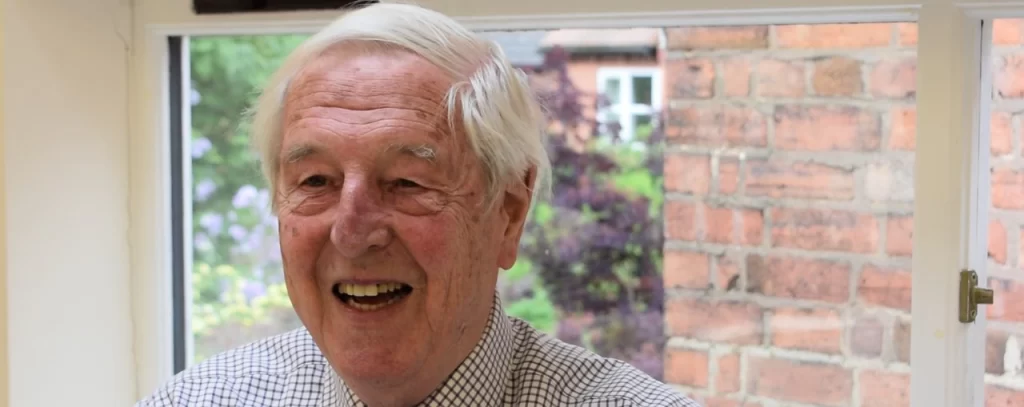
Distinguished academic, family man, and devoted Catholic who started a family of charities based on the principle of human dignity, awarded an MBE for services to vulnerable people, known for his magnetic, visionary, and inspiring personality.
Professor John Joseph “Jack” Scarisbrick MBE KSS FRHistS FRSL was born in October 1928 in London, the last of five children.
Jack was educated at The John Fisher School in Purley, Surrey. After spending two years in the Royal Air Force, he read History at Christ’s College Cambridge, learning from the distinguished Benedictine scholar Dom David Knowles. He completed his doctorate in 1955.
Renowned historian
In 1960, Jack was commissioned to write a biography of King Henry VIII. Eight years later, and three years after marrying Nuala Scarisbrick, Jack’s Henry VIII was published to widespread critical acclaim. It is still considered by many to be the standard text on England’s most infamous monarch. Historian David Loades described it as a “magisterial biography” that has “stood the test of time, and of other scholarship, remarkably well”; Steve Gunn of the Times Literary Supplement said, “It is the magisterial quality of J.J. Scarisbrick’s work that has enabled it to hold the field for so long.”
As part of his distinguished academic career, Jack was Professor of History at the University of Warwick (1969-1994). He also taught at the University of London, in Ghana, and the USA. After the success of Henry VIII, the sky was the limit for the renowned Tudor historian.
Servant to the vulnerable
In 1970, however, the devoted Catholic, alarmed by increasing assaults on human dignity, gave up a promising career to start a family of non-religious organisations promoting the principle that all people are special and equal.
As part of his distinguished academic career, Jack was Professor of History at the University of Warwick (1969-1994). He also taught at the University of London, in Ghana, and the USA. After the success of Henry VIII, the sky was the limit for the renowned Tudor historian.
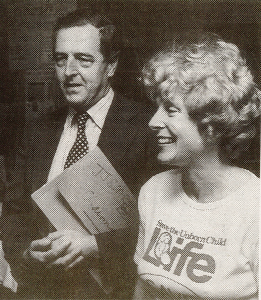
Life co-founders Jack and Nuala Scarisbrick at the Life National Conference in Leamington Spa, 1977.
Jack and Nuala co-founded the pregnancy support charity Life. The husband-and-wife team were the dynamic duo driving the charity all the way until Jack’s retirement as Chairman of Life in 2017, after 47 years of dedicated service.
Jack and Nuala also co-founded Life FertilityCare (now Fiat FertilityCare™) in the 1990s. This service offers Natural Family Planning, a cheaper alternative to IVF that does not involve waste embryos. More than 200 babies would be born from this programme.
He also founded Zoe’s Place Hospices, a children’s hospice charity providing palliative, respite, and end of life care to babies and infants aged from birth to five years suffering from life-limiting or life-threatening conditions.
For his services to vulnerable people with Zoe’s Place, Jack received an MBE in the Queen’s 2015 New Years Honours list.
He was also made a Knight of the Papal Order of Saint Sylvester by Pope John Paul II in 1993, in recognition of the work of Life. Nuala was made a Dame of the same Order at the same time.

Jack receiving his MBE for services to vulnerable people, 2015.
Stories of Life
Why Jack started Life
Three things inspired Jack to start Life. The first two reasons, which he recalled in an interview in 2016, were intensely personal:
“I think it was becoming a father and realising that … that child had been a reality, a human being, for nine months before I actually held it in my arms. It was the enormity of distinguishing between born life and unborn life.
"Secondly, we had a pregnancy that – alas – failed, miscarried. But it came very soon after our first child was born. We were due to go to a teaching post in America. And all these plans [were] in turmoil when we discovered [that Nuala was pregnant].
"And I realised how easy it was to panic … All sensible people were saying we could just quietly get rid of it … I could understand therefore why the crisis pregnancy is such a real crisis.”
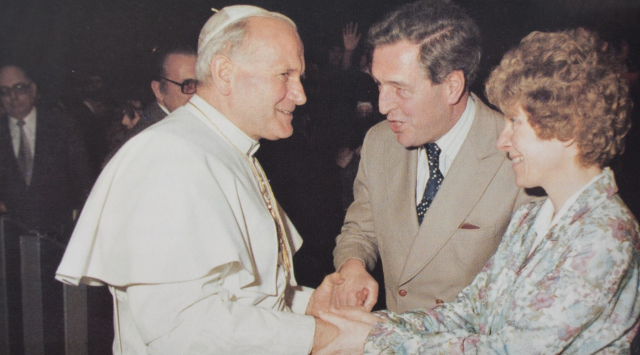
Jack and Nuala meet the newly-elected Pope John Paul II, 1978. The Pope, hearing about Life a at a General Audience in Rome, says, “What you are doing is very important for the modern conscience.”
The third reason was Jack’s dissatisfaction with the fledgling anti-abortion movement. He felt it was neither consistent in its dedication to human dignity, nor offering a positive alternative to abortion:
“The greatest weakness of the prolife movement, I think, is its failure to always combine a care service with its advocacy and campaigning … It’s so easy just to say ‘thou shalt not.’ … It’s got to be able to always show that it’s a loving, positive thing and not judgmental, not sanctimonious, not on a high horse, but actually out there, rolling up their sleeves and helping people.”
“It is very very important that the prolife movement should always be seen to be a loving, caring one. It’s so easy to sound shrill and sanctimonious. And without a care service, a prolife movement can easily become that.
“We’ve got to accept that the crisis pregnancy can be a terrible thing. It can seem like the end of the world … ruin her life, break her parents’ heart, and so forth. We’ve got to understand why people panic and go down the abortion road. And we must love them when they do it … and do all we can to help them.”
Life therefore combined education about human dignity, pregnancy, and abortion with what Jack described as “a counselling and support service inspired by the Samaritans.”
Life’s counselling and support service
The care service was originally taking pregnant girls into private homes. Parents to two young daughters themselves, Jack and Nuala hosted pregnant women at her own home in Leamington Spa. At one point there were five young expectant mothers living with the Scarisbricks, either because they had nowhere else to live, or because families or boyfriends had abandoned them. Over the years, up to 30 single mothers lived in the Scarisbrick family home. Inspired by their example, many supporters did the same.
As Jack recalled
“There were lots of great stories – not all printable! I remember in the early days we had four girls staying at our house and in turn they all went to the local maternity hospital. I would take flowers to the girls to celebrate the birth of their babies, much to the matron’s dismay who thought I was the stallion of Leamington!”
This service later expanded to a network of supported accommodation across the country, regulated by local authorities. By 1977, just seven years after Life’s birth, the charity had accommodated over 500 mums. In 2020, at its 50th Anniversary, it had accommodated over 12,000 mums and babies.

Angela and Simon, one of the first – if not the first – baby born in a Life House.
The care service also gave free emotional counselling via a national helpline, financial help, pregnancy tests, and mum and baby supplies to anyone facing pregnancy or pregnancy loss. By 1977, more than 4,000 women had been helped. Today, more than 180 women are reaching out to this service every single day.
While Jack was the figurehead for Life, it was his wife Nuala, a former teacher, who did the day-to-day running of Life. She was for some 30 years the full-time but unpaid National Administrator of Life. Jack described her as Life’s “chief animator.” Speaking of Nuala’s influence, he said:
“She [Nuala] ran Life for 25 years. And was amazing! Travelling all over the place, all over Europe, and addressing numerous meetings and founding the National Helpline. She was a leading figure on it for many years. Really without her, it would never have taken off as it did.”
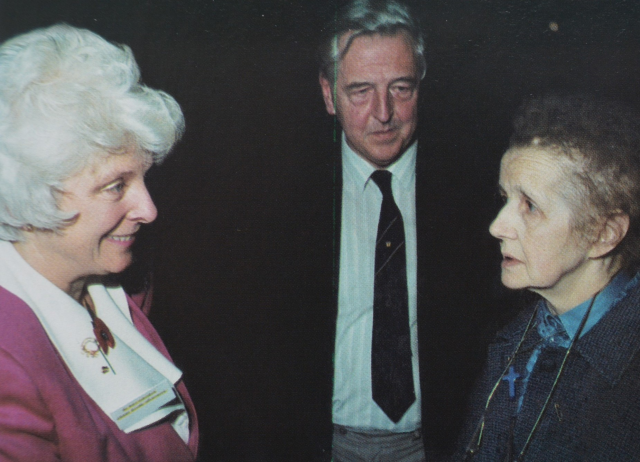
Nuala and Jack with Sue Ryder, who gave a memorable address at a Life National Conference in 1995. Her husband, Leonard Cheshire VC, had been a patron of Life from the early days, and the two had supported Life’s work.
The work of helping women and families in these tough situations had a profound effect on Jack:
“I have seen and heard girls say so often that the birth of their child … is an unspeakably precious experience.”
“Being a mother obviously isn’t always easy. There’s always going to be challenges and so on. But it’s always something to be proud of.”
Life’s education and advocacy
In addition to the care service, Life also had an education and advocacy service, which was equally integral to Jack’s original vision. It was started to advance public education on all matters relating to pregnancy and, in particular, to human dignity and respect for human life. This service has spoken to millions of school pupils about these topics.
Life’s work also extended to politics. In the late 1980s, Jack helped to organise the biggest parliamentary petition since the Chartists – two million signatures in support of protections that would have curbed human embryo abuse.

Jack (right) and Raymond Johnson (centre, then Director of CARE) present Norman St John Stevas MP with a petition signed by over two million people urging Parliament to protect human embryos from all forms of abuse.
Hope for the future
Reflecting recently on Life, Jack said:
“Life got it right. It was the right approach. That was something that we can … be proud of. Continue innovating and extending. It’s not enough to be doing tomorrow what we are doing today – you must find new ways to meet new needs and new ways to change the culture.”
Distinguished academic
While spending his life in service to the principle of human dignity, Jack also found time to continue his academic career.
He was elected a Fellow of the Royal Historical Society in May 1962 and served on the Society’s Council between 1978 and 1982. He was also was elected a Fellow of the Royal Society of Literature in 1969.
In addition, he is known as a founder – if not the founder – of Catholic revisionism, an academic movement which challenged preconceptions about the Christian Reformation and revolutionised Reformation studies. He also continued to study and write historical books and essays, specialising in Jesuit missionary history.
Family man
Jack married his wife Nuala in 1965, who died in 2021. They lived in Leamington Spa. They are survived by two daughters, eight grandchildren, and ten great grandchildren.
How he wanted to be remembered

Jack and Nuala on their 50th wedding anniversary, 2015.
When asked how he wanted to be remembered, Jack paused, before saying:
“I hope I will be remembered as somebody who helped to start something that was worth starting.”
You did, Jack. You did.